Showing posts with label 1980's. Show all posts

Friday, January 22, 2010

Dar & Receber - António Variações


It's odd that among all of Europe's great pop music eccentrics, some garner sizable cult audiences in the US and UK, while others achieve great success in their native countries while passing virtually unnoticed by the American and British pop/rock cognoscenti. Cult legends like Serge Gainsbourg and Jacques Brel remain college radio staples in the English-speaking world, while even less iconoclastic musicians like Goran Bregović, Boris Vian, Lucio Battisti, Selda Bağcan, and Pugh Rogefeldt have small followings outside of their homelands. It's unfortunate then, that António Variações, one of European pop music's great innovators and oddballs, remains woefully obscure even after having achieved great success in his native Portugal, as well as having essentially changed the face of Portuguese pop music in the 80's with his clever mixing of synth-pop and electro-rock styles with more traditional Portuguese forms such as fado. And for anyone who counts his/herself as a member of Sparks' fanbase, Variações will sound like manna from heaven. Ironic, since Sparks, an American group, were abysmally unsuccessful in the US, while racking up many hits in Europe. But truly, this sounds so much like Sparks that it's impossible to ignore: the almost goofy synth-rock beats, the sweet falsetto vocals, and the general flamboyance all call to mind the Mael brothers' best work. But to label Variações as a mere Portuguese imitation of those underground rock pariahs is to miss the glorious individuality of his work. Dar & Receber, the last album he recorded before dying of AIDS-related illness in 1984, is a masterpiece of European pop music. Halfway between new wave and Iberian folk music, it's one of the most underrated classics of the 80's. "Canção de Engate" was the hit, a song that, for many Portuguese, iconicized the civil liberalization that followed the Carnation Revolution of the 70's. The rest of the album is just as iconic, and just as exciting, and if you feel the need to put a face on the man behind the music, google Variações to see one of the most singular styles of the 80's... scissor-shaped glasses ought to have been big.

Tu estás livre e eu estou livre.

Monday, November 16, 2009

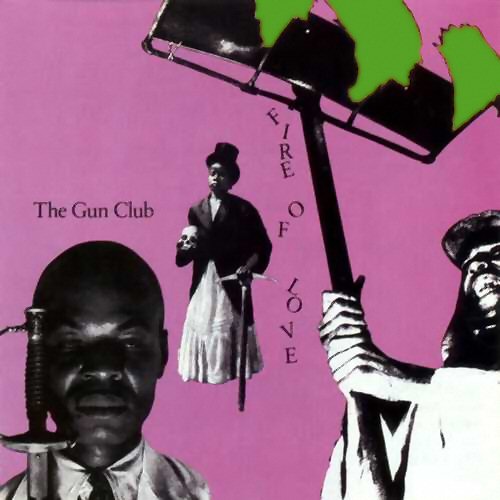
Fire Of Love - The Gun Club


Distorted, savage blues have long been a cherished American institution, from the satanic verses of Robert Johnson through the whacked-out mumbo jumbo of Captain Beefheart to the high-voltage punk blues of the early White Stripes. And in the annals of frenzied, voodoo-addled blues legend, Jeffrey Lee Pierce and The Gun Club stand alone as the undisputed kings of swamp punk: blues twisted into a barely recognizable form by drugs, black magic, and white kids barely learning to play their instruments. Fire Of Love dropped in 1981 and almost immediately changed the face of American roots music. While similar roots-punk groups like X were indulging their artier inclinations through poetic punk, and The Cramps were hamming it up and inventing "psychobilly", The Gun Club went straight for the jugular, hammering out eleven tracks of fiendish death rock that pulled together the most macabre aspects of blues, country, and primitive rock 'n' roll to create something altogether new and shocking. Jeffrey Lee Pierce's primal howl and descriptions of "huntin' for niggers down in the dark" and "fuck[ing] you 'til you die" still manage to sound both haunting and exhilariting, while the band creates a tense, sparse atmosphere of bottomless bass and slide guitar to back up his fearsome ranting. The band's frantic rendition of Robert Johnson's "Preachin' The Blues" teems with cathartic energy, while the reckless insanity of "For The Love Of Ivy" remains an unparalleled peak in roots rock nearly three decades after its recording. Elsewhere, "Ghost On The Highway" and "Fire Spirit" brim with horrific imagery and punk vigor, cementing Fire Of Love's reputation as a stone-cold classic from start to finish.

Friday, November 13, 2009

BIPPP: French Synth Wave 1979-85 - Various Artists


The jury's still out on whether or not the French can rock, but when it comes to robotic jerking and convulsing, the French are kings. France's disco history has been well-documented thanks to big names like Daft Punk and Justice, but their history of robot rock is much more obscure. The French have always displayed a penchant for dabbling in the latest musical electronics, from the tape collage experiments of Pierre Schaeffer, to the hokey Moog rock of Jean-Jacques Perry and Pierre Henry, through the brief "space disco" craze of the late 70's, and living on in various incarnations through Air, the Ed Banger crew, and of course, Daft Punk. But what happens when the Gauls think to combine the computer sounds they love so very much with the tension and aggression of punk? (It may come as a surprise to some to learn that there is French punk other than "Ça Plane Pour Moi") The result is something like Suicide transposed from CBGB to Studio 54, en Français. Most of this collection comes from the post-disco era, however, so that's not quite an accurate summation of this sound. Honestly, it sounds like most early 80's "death disco" or early electro pop, but it contains rather unique strands that are difficult to classify. Some of this might alienate all but hardcore Francophiles (A Trois Dans Les WC's "Contagion", for instance), while more dance-oriented tracks like "Je T'ecris D'un Pays" from Les Visiteurs Du Soir and Act's "Ping Pong" would probably sound perfectly-suited to your local indie dance club. Enjoy it for what it is: French synth-punk. After all, did you even know that such a thing existed up until now?

Wednesday, November 4, 2009

Wa-Do-Dem - Eek-A-Mouse


Let's start with the disclaimer: Eek-A-Mouse will sound to some like a breath of Jamaican fresh air. To others he will sound irritating, juvenile, and downright bizarre. Even hard-boiled reggae fans may balk at his unorthodox delivery, incoherent babbling, and cartoon character vocals. With that said, this record is darn cool. Sounding like Mickey Mouse smoking a huge spliff, Eek-A-Mouse, for better or worse, did much to chart the course of reggae in the 80's as the first dancehall toaster of his type: a babbling, eccentric hooligan with a pocketful of nonsensical rhymes and a penchant for odd, synthesized riddims... no wonder all of my stoner friends love him. Sure, there's plenty of dub fire here (dub magnate Linval Thompson produced some of Eek's early singles), but the focus is most definitely not on thunderous bass riffs or brain-nuzzling echo effects. It's all about Eek-A-Mouse, one of the most singular reggae vocalists of all time. He's not quite a singer (he certainly has no talent for rocksteady or lover's rock), but he's not quite a DJ in the manner of Big Youth or Dennis Alcapone either. Think of him instead as the prototypical dancehall DJ: a pioneer from an innocent period in dancehall history when a loose-limbed kid like Eek could virtually scat over a tinny, cheap beat and craft a helluva good song out of it. The slippery title track saunters over a charming dub-lite beat, while "Operation Eradication" gets dirtier with a slinky organ-based roots groove, and "War Don't Pay" harnesses a fab percussive dub track for Eek's loose crooning.

Tuesday, October 20, 2009

In The Flat Field - Bauhaus


Goth rock never got any better than Bauhaus. Creeping out of the shadows in 1979 with "Bela Lugosi's Dead", one of the most gloriously macabre pop singles ever released, Bauhaus defined the sound of gothic post-punk: crawling, shuddering, lurching; glam rock with a death trip. The band's first album, In The Flat Field is a real symphonie des Grauens, an apocalyptic festival of shadowy textures and fractured, jagged melodies. Like Bowie in the depths of some nightmarish opium binge, lead ghoul Peter Murphy whoops and howls like a banshee, switching between sickly grin and horrific grimace. The rest of the band is equally dynamic, conjuring a fever dream of a sonic landscape, the likes of which had never been heard in pop music. The title track and opener, "Double Dare", are ferocious and immediate; relentless in their assault on punk's increasing creative lethargy. While there's nothing here quite as monolithic as "Bela Lugosi's Dead", the seven-minute closer "Nerves" comes close, an eerie dirge that alternately oozes and rages: German Expressionism for the 1980's.